The Hermetic Order of the Golden Dawn, Alpha et Omega
You Were Right —
Something Is Missing
If you have ever felt like an outsider to something you can’t name — restless when nothing is wrong, going through the motions of a life that looks fine from the outside — this page was written for you. This is a working initiatory Order in the Hermetic, Rosicrucian, and Golden Dawn traditions. What’s been missing may have a very old name: initiation.
First-year enrollment: $297 — begins the Outer Order curriculum at Neophyte, 0=0.
- Founded 1888
- 612 lessons
- Personal tutor
- 60-day guarantee
The Ache
You’ll Recognize It If You Have It
It doesn’t always look like a crisis. Often it looks like success. The career is fine, the life is fine — and underneath it, a hollowness you can’t explain. An itch that can’t be scratched: nothing you buy, finish, or achieve relieves it. Work, eat, sleep, repeat — and a quiet question underneath it all that never entirely goes away.
If you have ever put words to it, they were probably these: something is missing. Not something small — something structural. A foundation that should be there and isn’t. A door you were meant to walk through and never found.
Tradition teaches that the feeling is exactly what it feels like: you are standing outside something. For more than a century, seekers who found their way to the Golden Dawn tradition have reported the same recognition — the ache did not need to be numbed or explained away. It needed a threshold.
The Scattered Path
If You’ve Already Tried, It Wasn’t You
Maybe you have gone further than most. A house full of books that never quite fit together. Rituals performed alone in which you felt — nothing, and then felt silly for having tried. Courses begun and abandoned. Systems that contradicted each other until the whole subject turned to noise. If that is you, hear this plainly: the failure was probably not yours.
For most of a century, the Golden Dawn system has reached seekers in fragments — rituals in one book, theory in another, the sequence lost and the guidance gone. A fragment cannot do what the whole design does. Robes and props were never the problem, and neither were you: a rite stripped from its structure is a costume without a body. What’s been missing is not more intent, more books, or more effort. It is the whole design — the right work, in the right order, under the eye of someone who has done it.
That is what an Order is for. The Alpha et Omega carries the complete system — the graded sequence, the examinations, the tutors, the initiations — intact, as a single body of work preserved without interruption since 1888. And by the Reformation of 1999, the practical magical work begins in the first grades — not after years of theory. What the work offers is not a costume or a title, but the thing underneath the ache itself: the chance to become genuinely different — more capable, less governed by reflex and circumstance — through training that is real, structured, and earned.
Members Speak
Reports from Inside the Work
★★★★★5.0
“I was initially skeptical about the Golden Dawn and Magick because there is so much sanctimonious, fluffy bunny stuff in the esoteric world. The effect of the Golden Dawn Neophyte initiation followed by the spiritual practices put my doubts to rest forever.”
★★★★★5.0
“I have always had reservations about any tradition promising things far beyond one’s own reality, but any doubts I had were totally blown away by Golden Dawn initiation and practice. This is the real thing!”
★★★★★5.0
“I have seen profound, positive transformation, not only in myself, but also in my relationships, and in others on the same Path. I have gained self-mastery, knowledge, and peace within. I have been able to let go of past issues, fine tune my innate talents, and awaken latent ones.”
★★★★★5.0
“The Golden Dawn has shown me that I am Master of my own Destiny, rather than merely the product of my social conditioning.”
★★★★★5.0
“I wholeheartedly recommend studying in this Order, which stands unsurpassed for its academic standards, support system and the integrity of actual physical initiations, preserving the age-old initiatic stream that I always dreamed existed.”
Before You Continue
Who This Is For
This Order is for you if
- You are a serious student of Hermeticism, Rosicrucianism, the Golden Dawn tradition, or Western esotericism — or you are new, and done with wandering.
- You have studied alone and want structure, sequence, and a tutor — not another pile of fragments.
- You are willing to begin at the beginning, regardless of prior study elsewhere.
- You are prepared to study, practice ritual work, and be examined as you progress.
- You want disciplined symbolic and magical training carried within a documented lineage — not entertainment or spectacle.
- You can commit real time to the work, not just the purchase.
This Order is not for you if
- You are looking to buy rank, status, or spiritual authority.
- You expect instant power, secret advantage, or guaranteed transformation.
- You are unwilling to study or to be examined on what you study.
- You want a social club, a costume stage, or casual occult entertainment.
- You expect all curriculum, including higher-grade material, unlocked immediately on payment.
Who We Are
A working initiatory Order
The Hermetic Order of the Golden Dawn, Alpha et Omega is an initiatory order in the Hermetic, Rosicrucian, and Golden Dawn traditions. It exists for one purpose: the transmission of a complete system of esoteric training — by initiation, by a graded curriculum, and by personal work undertaken with the guidance of experienced members.
We are plain about what we are. We are not a religion, and membership does not require leaving one. We are not a social club or a stage for costume. We make no promises of wealth, power, or hidden advantage. We offer a defined course of work — study, practice, examination, and initiation — within a tradition that has been carried, taught, and reformed for well over a century.
Admission is deliberate. Members advance through the traditional grades at the pace of their own work, examined and guided by tutors. What can be said publicly about the Order is on this page; what belongs to the grades remains in the grades.
Lineage
Descent, stated plainly
The Hermetic Order of the Golden Dawn was founded in London in 1888 by William Wynn Westcott, Samuel Liddell MacGregor Mathers, and William Robert Woodman, with the chartering of Isis-Urania Temple No. 3. Its rituals were developed from the Cipher Manuscripts, which reached the founders through the English adept Kenneth MacKenzie, whose own initiation derived from the continental Rosicrucian lodges of the nineteenth century — among them the Frankfurt lodge Loge zur Aufgehenden Morgenröthe, “the Rising Dawn,” counted in our tradition as the Golden Dawn’s first temple.
In 1891, Mathers established contact in Paris with a representative of the continental order from which the tradition descends, and upon the material received the Second Order was constituted in 1892. In 1906, Mathers gave the original order its mature name: the Rosicrucian Order of Alpha et Omega. The Alpha et Omega was not a splinter or a successor body — it was the founding order itself, continued without interruption under Mathers and, after his death in 1918, under Moina Mathers.
The system was preserved through the twentieth century by the temples that kept it working. Israel Regardie, initiated at Hermes Temple in Bristol in 1933, consecrated a Vault of the Adepts in the United States in 1982 and initiated Cris Monnastre; under her guidance David Griffin entered the Order in 1992 and was made an Adept in Regardie’s Vault in 1994. In 1997, in Paris — through the revived Ahathoor Temple No. 7, Mathers’ own mother temple of the Alpha Omega, and the adepts Jean-Pascal Ruggiu and Nicholas Tereschenko — the surviving European lineages of the Alpha et Omega were united with the American line, and David Griffin received the grade of Adeptus Exemptus, the traditional authority to govern temples within the tradition.
David Griffin serves as Imperator of the Order, and Leslie McQuade as Chief Adept. In 2002, one hundred and eleven years after Mathers’ meeting of 1891, the chiefs of the Order renewed contact in Paris with the continental source of the tradition. We state our history plainly and do not embellish it; a fuller documented account, with sources, is being prepared for publication on this site.


- 1888
- The Hermetic Order of the Golden Dawn founded in London; Isis-Urania Temple No. 3 chartered.
- 1891–92
- Contact in Paris; the Second Order constituted.
- 1906
- The founding order takes its mature name: Rosicrucian Order of Alpha et Omega.
- 1982
- Israel Regardie consecrates a Vault of the Adepts in the United States.
- 1994
- David Griffin made an Adept in Regardie’s Vault.
- 1997
- European and American lineages united in Paris; Ahathoor Temple No. 7.
- 1999
- The Reformation: the curriculum of the Order reorganized.
- 2002
- Contact with the continental source of the tradition renewed in Paris.
The Reformation
Why this Order is different
Rosicrucian orders do not treat their constitutions as fixed for all time. The tradition provides for periodic general reformation — historically at intervals of one hundred and eleven years. The German Rosicrucians reformed their order in 1777; the Golden Dawn itself was founded in the reformation year of 1888; and in 1999 the Alpha et Omega undertook the reformation of its own era.
The Reformation of 1999 is the defining difference of this Order. Its effect was a deliberate reorganization of the initiatory material: teachings long reserved to the Third Order were placed in the Second Order, and the magical material of the Second Order was brought forward into the Golden Dawn in the Outer, where it was merged with the traditional Theoretical Knowledge Lectures. The Outer Order of the Alpha et Omega thereby became a complete magical training in its own right — rather than a course of theory rewarded with practice only after years of waiting.
That is the high-level account, and it is all that belongs on a public page. The contents of the reorganized grades are oath-bound, as they have always been. An applicant learns them the way they have always been learned: by grade, in order, by doing the work.
Curriculum
The grades of the work
The curriculum is structured through the traditional grades of the Golden Dawn:
- 0=0Neophyteentrance into the Order and its current of initiation
- 1=10Zelatorthe grade of Earth
- 2=9Theoricusthe grade of Air
- 3=8Practicusthe grade of Water
- 4=7Philosophusthe grade of Fire
- PortalThe Portalthe threshold of the Second Order
What distinguishes the Alpha et Omega is what the grades contain. By the Reformation of 1999, Third Order material was moved into the Second Order, and Second Order material into the Golden Dawn in the Outer, merged with the existing Theoretical Knowledge Lectures. Practical magical training therefore begins early: the Greater Invocation Rituals are taken up in the grade of Zelator, 1=10 — work that older arrangements of the system withheld until well into the Second Order.
Each grade joins study to practice: Knowledge Lectures to be mastered and examined, ritual work appropriate to the grade, and the guidance of a tutor. The ritual corpus of the Order is printed in The Ritual Magick Manual by David Griffin; the graded instruction that surrounds it is given to members within the grades.
Before You Enroll
What Your Enrollment Means
Enrollment begins the Outer Order work. It does not purchase rank, advancement, initiation status, or authority within the Order, and it does not grant access to material reserved for grades you have not yet reached.
Every member begins at the same place: Neophyte, 0=0. From there, advancement through the grades — Zelator, Theoricus, Practicus, Philosophus, and the Portal — depends on study, ritual practice, and examination by a tutor. That is true regardless of background, prior training elsewhere, or how long someone has been a member. There is no faster path through payment alone.
Material belonging to grades above your own remains protected until you reach them. This is not a withheld upsell; it is the same boundary the Order has kept since 1888, applied without exception. What your first-year enrollment opens is the complete Outer Order curriculum at the grade you are entitled to — the Knowledge Lectures, the practical ritual work merged into the Outer by the 1999 Reformation, and the guidance of a tutor to take you through it.
Enrollment
Join the Order Today
Membership opens the complete Outer Order curriculum immediately on enrollment — the whole design, in sequence, with a tutor who answers and a community of initiates working the same grades. No waiting list. No correspondence course gathering dust. No more piecing it together alone. The work begins the day you join.
First-year enrollment
$297 for your entire first year
- Immediate admission at the grade of Neophyte, 0=0 — the same starting point for every member
- 612 lessons across the curriculum — online, PDF, audio, and video — including the 10 courses and 144 lessons of the Neophyte grade
- Two live webinars every month — Ritual Magick coaching and Golden Dawn topics (a $197/month value)
- Monthly email mentoring from an elder of the Order, and access to the initiates-only community forum
- Five digital texts included at no extra cost (a $296 value)
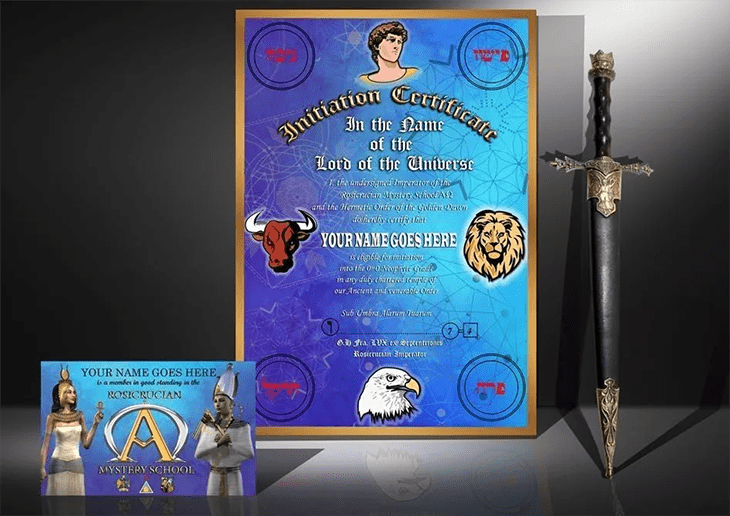
- A physical welcome kit — magick blade, Rose+Cross Stargate Talisman (only 300 made), membership card, and initiation certificate (a $297 value)
Everything included in your first year: a $2,383 total value — for $297.
Live webinars every 1st & 3rd Saturday of the month.
Begin the Outer Order curriculum · First-year enrollment: $297 · Progress through the grades is earned through the work · Secure checkout
Backed by a 60-day, 100% money-back guarantee — no questions asked.
Every member starts at the beginning, in good standing, with full access to the grade they are entitled to. What belongs to a grade is given on entry to that grade; what belongs to the grades above remains there until earned by examination and the work itself — that boundary has never changed and is not for sale. Your enrollment is confidential and is never shared or sold.
After You Join
What Happens After Checkout
- You complete checkout. Payment is processed securely; you are not asked any further questions before access is granted.
- You receive joining instructions by email, typically within one business day, including your member portal credentials.
- You begin at Neophyte, 0=0 — the first grade of the Outer Order, the same starting point for every member.
- You receive access to the curriculum for your grade: lessons, texts, and the practical ritual work belonging to that grade.
- You receive instructions for the live webinars, monthly mentoring, and the initiates-only forum, along with shipping details for your physical welcome kit.
The physical welcome kit typically arrives by mail within about two weeks; digital access does not wait on the mail.
Frequently Asked
Before You Join
Am I buying initiation or rank?
No. Enrollment opens the Outer Order curriculum at the grade of Neophyte, 0=0, for everyone. Rank and advancement are earned through study, practice, and examination — never purchased.
What do I get immediately after checkout?
Joining instructions and member portal access by email, the Neophyte-grade curriculum, and instructions for webinars, mentoring, the forum, and your physical welcome kit.
When do I receive access?
Email access instructions typically arrive within one business day of payment. The physical welcome kit ships separately and arrives by mail.
What happens after my first year?
Your $297 enrollment covers a full year of membership. Renewal terms are communicated to you well before your year ends, and you may cancel at any time — nothing is charged without notice.
What is the refund policy?
A 60-day, 100% money-back guarantee, no questions asked.
Is higher-grade material included immediately?
No. Material belonging to grades above your own remains protected until you reach them through study and examination — the same standard that has applied to every member since 1888.
Is this online, in person, or both?
The curriculum, webinars, mentoring, and forum are online. The welcome kit is a physical item shipped to you.
Why does every member begin at the beginning?
Because the grades build on each other, and because rank in this Order reflects work actually done, not time elapsed or money paid. Beginning at Neophyte applies without exception, regardless of prior training elsewhere. Prior study is not wasted — it tends to ripen quickly inside a structure.
I’ve been burned by books and courses before. How is this different?
Books and courses hand you fragments and leave you alone with them. Membership places you inside the whole design: a graded sequence, examinations that confirm what you have actually gained, a tutor who answers, and a community working the same grades. And it is backed by a 60-day, 100% money-back guarantee — if it is not what you hoped, you risk nothing but the look.